Personal Curriculum: Learn Anything, For Reasons Entirely Your Own
There's a dopamine hit that comes from satiating curiosity. It's a reward pathway the brain never tires of.
I wanted to ride that wave when two videos about "personal curriculum" appeared in my YouTube feed. Curious, I checked Google Trends to see if this was part of a larger trend. It was. "Personal curriculum" is in the zeitgeist.
On Google Trends, Third Time's the Charm
The search data tells a story in three parts.
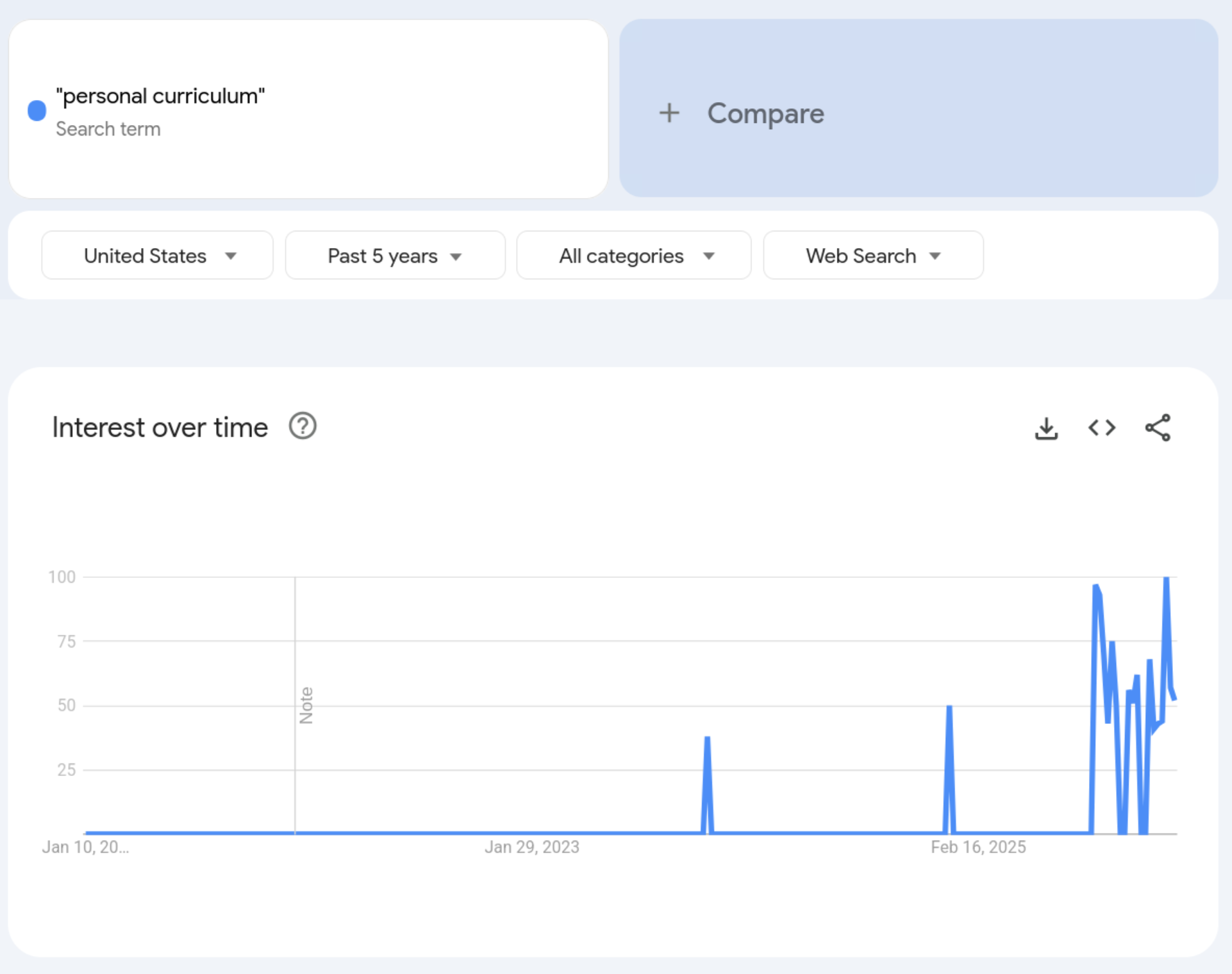
The first blip came in late 2023 and did not go viral. It was likely tied to an academic paper by Stephen Billett titled "The personal curriculum: conceptions, intentions and enactments of learning across working life." His thesis: curriculum should be understood as a personal pathway of experiences across one's life, not just what educational institutions provide. Interesting, but utilitarian. His focus was career sustainability and workforce development.
The second blip appeared in late 2024, driven by unrelated news from Michigan's education policy about a formal state program letting students modify graduation requirements. Nothing to do with self-directed adult learning.
The third roller coaster of interest started with Elizabeth Jean, a 30-something TikToker and former sommelier. She posted the following video in June 2025 about her very own "little school," where her self-directed curriculum only includes what she actually wants to do. Something clicked with her followers and they wanted their own personal curricula, too. By fall 2025, CNN, Newsweek, CBC, and Today were all covering the trend. Her concept of a personal curriculum had gone viral and hashtags like #curriculumclub began to gain traction.
Elizabeth Jean's June 2025 Personal Curriculum TikTok Post
What Made "Personal Curriculum" Go Viral?
Elizabeth Jean's philosophy represents something genuinely new in self-education. The new feature is the complete absence of external justification.
Consider the historical precedents:
- Studia humanitatis in the Renaissance -> learning for civic virtue and moral improvement.
- Victorian self-improvement -> learning for respectability and "rational recreation."
- Great Books programs -> learning for liberal education and civilization.
- Lifelong learning -> learning as a way of life for societal benefit. Self-directed, but not a structured practice.
- Unschooling -> learning for kids, with parental permission. Close to personal curriculum, but adults still set the boundaries.
Every major self-education movement has had some external justification. You learn for something outside yourself: career, virtue, civic participation, society, parents, etc.
Elizabeth Jean's approach is different. It's learning for the enjoyment of the learner, period. With a personal curriculum, there's nothing the learner "should do" for the benefit of someone else. There's only stuff to do that the learner chose for themself with no one's permission needed.
Elizabeth Jean's "personal curriculum" is for adults, not children. Any topic is fair game. Study soup, octopuses, Gossip Girl, or Mary Kate and Ashley movies. Anything goes that can spark curiosity and offer some fun.
"It's for you, right? It's supposed to be fun."
That's Elizabeth Jean's core message. And that simple permission to learn without having to serve a purpose is why it went viral.
Dale Carnegie Would Approve
That's not to say there's no benefit to society when people develop personal curricula. Quite the opposite.
Dale Carnegie, the practitioner of social dynamics who studied what actually makes people likable and memorable, had an empirical observation:
"To be interesting, be interested."
Carnegie wasn't philosophizing. Starting in 1912, he taught thousands of students at YMCAs and hotels, calling his classes "the first and only laboratory of human relationships for adults that had ever existed." He discovered through practice that curious people are more socially compelling. The energy of genuine interest is itself attractive.
Carnegie would look at someone who spent a month studying soup and say: that person will be fascinating at dinner parties. Not because soup is important, but because the curiosity itself is magnetic. The topic is irrelevant. The energy of caring enough to explore is everything.
This is why Elizabeth Jean's "useless" topics aren't useless at all. They produce exactly what Carnegie observed makes people engaging: genuine interest in something, anything.
Curiosity is Contagious
Elizabeth Jean ditched obligation and followed curiosity. It struck a nerve. People wanted to be like Elizabeth Jean and make their own personal curriculum.
Here's some insight into what works, directly from Elizabeth Jean's TikTok feed:
Stay in tune with the fun factor. As Elizabeth puts it:
"I'm a very intuitive person, so if something feels fun and good for me, I just follow that feeling."
Start with a question, not a topic.
Her starter question: "What would my inner child want to be spending time on?"
If you don't know what to learn, think of one to three questions you want answered. Questions about the world, about existence, about whatever. Go to the library, walk the aisles, see what jumps out.
"Go out and see physical media, because even if maybe you're not going to get something, you can be inspired."
Leverage curiosity and intuition.
"I like to explore through learning. I've always been a self-motivated learner. I just want to know things. I'm a nosy lady."
Trust yourself.
The "reward" of monthly learning is "listening to yourself," as no one else can do the work for you.
There are no rules. No timelines. No consequences for not finishing.
"When I'm done with it, I just, like, move on to the next thing or I continue, like, learning about whatever. And it's just so fun cause there's no rules."
If things roll over to next month? No shame in that. Adjust your pace to what works. Elizabeth has ADHD so some of her projects took nine months instead of the planned one to three months.
"It is what it is. It got done."
Stay playful.
Learning doesn't have to be serious to be worthwhile.
"It is so much fun to just learn for the sake of being silly and curious, right?"
How to Start Your Own Personal Curriculum
If you want to try this, the next step is putting it into a trusted system.
Gorilla Tasks is one such system where you define a set of activities: what to watch, read, listen to, and do, and what order to do them in. You can promote those activities from a "Study Inventory" page to a "To Do Today" page that serves as your launching ground.
Time tracking is built in so you can see where you spend your time over periods of weeks, months, and years. You can also view completion statistics.
Try it out by signing up for Gorilla Tasks and uploading the "Introduction to Personal Curriculum" course, which is a simple CSV file with 13 things to read, watch, or do.
Then, download an empty Excel template, make your own curriculum, save it as a CSV file, and upload it the same way.
Enjoy the journey!